Response of the Human Rights Ombudswoman to a letter from the Mayor of Novo mesto


The Human Rights Ombudswoman of the Republic of Slovenia, Dr Simona Drenik Bavdek, responded to the Mayor of Novo mesto’s letter regarding the Constitutional Court’s decision to suspend the implementation of Article 8 of the Act on Urgent Measures to Ensure Public Safety (ZNUZJV).
The Constitutional Court is the highest judicial authority responsible for protecting constitutionality, legality, human rights, and fundamental freedoms. Due to serious doubts regarding the conformity of the regulation with the Constitution, the Human Rights Ombudswoman decided to refer the ZNUZJV to the Constitutional Court for constitutional review, proposing the temporary suspension of the contested provision pending a final decision on its constitutionality.
Upon filing the request for constitutional review, the Ombudswoman emphasised that “the state’s concern for the safety of its residents is undoubtedly necessary; however, the state must pursue this objective in a manner consistent with the Constitution and human rights standards. Article 8 of the ZNUZJV and the related provisions interfere with cash social assistance in a way that raises serious concerns as to their constitutionality.”
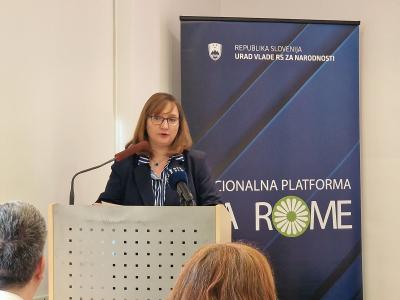
She is also aware that repressive measures alone, such as those envisaged by the ZNUZJV, cannot produce the desired effects or improve coexistence at the local level. A coordinated and professional approach is required—one that delivers positive effects in the medium and long term. To this end, she has already visited the Municipality of Ribnica, met with primary school principals, and participated in discussions on ensuring healthcare for members of the Roma community. On 13 April 2026, she met with representatives of the Office of the Government of the Republic of Slovenia for Nationalities. She is also examining individual cases of persons who have had negative experiences with both the implementation of the legislation and certain members of the Roma community. Next month, the Ombudsman will hold sessions in the Municipality of Novo mesto, where the Ombudswoman will meet with representatives of the police, the social work centre, and the local community.
In its annual reports to the National Assembly, the Ombudsman has highlighted tensions between differing perceptions for more than ten years. On the one hand, there is the perception among members of the Roma community that they are treated less favourably or more strictly by the authorities solely because of their origin. On the other hand, there is the perception among the majority population that Roma are able to act with impunity or benefit from various privileges precisely because they are Roma.
The Ombudsman has also long emphasised that everyone has the right to dignity and personal safety in accordance with Article 34 of the Constitution of the Republic of Slovenia, and that the police are obliged to protect any individual who seeks their assistance due to threats to personal safety or property. If effective protection is not provided, a complaint may be lodged with the Ministry of the Interior. The Ombudsman also consistently stresses the need for a police presence in Roma settlements where breaches of public order and peace, as well as other offences or criminal acts, still occur. Providing special protection to the Roma community or its members must not be equated with protection from liability for unlawful conduct. The customs and traditions of the Roma community do not justify unlawful acts. The special rights granted to the Roma community under Article 65 of the Constitution of the Republic of Slovenia do not in any way imply a waiver of the investigation or prosecution of criminal offences or misdemeanours. State measures must be effective and have a deterrent effect. In criminal law, everyone is equal before the law, and the police must respond to all incidents involving breaches of public order or peace, or other offences.
Last week, the Constitutional Court of the Republic of Slovenia adopted a decision to temporarily suspend the implementation of Article 8 of the Act on Urgent Measures to Ensure Public Safety (Official Gazette of the Republic of Slovenia, No. 93/25) at the initiative of the Human Rights Ombudswoman, Dr Simona Drenik Bavdek, and the Pravna mreža za varstvo demokracije (Legal Network for the Protection of Democracy). The Ombudswoman welcomed the decision, stating that the Constitutional Court had endorsed her proposal and arguments that the harmful consequences of continued enforcement—namely further seizures of cash social assistance intended to ensure the subsistence of individuals and families in distress—would outweigh the consequences of temporarily suspending the contested regulation. While the state can await the Court’s final decision on constitutionality, the needs of socially vulnerable individuals cannot. The Ombudswoman expects the Constitutional Court to reach a substantive decision on the constitutionality of the contested regulation as soon as possible. This would also represent an important contribution to constitutional jurisprudence on the protection of human dignity and the right to social security.
 Back
Back