
The Human Rights Ombudswoman Meets with Representatives of Društvo sodnikov porotnikov Slovenije (an association of lay judges in Slovenia)


ADDITIONAL CLARIFICATION REGARDING THE PRESS RELEASE – 15 April 2026
Following the publication of the news item below regarding the meeting between the Human Rights Ombudswoman, Dr Simona Drenik Bavdek, and representatives of the Association of Lay Judges of Slovenia, the Ministry of Justice has informed us that the Working Group for the Preparation of Systemic Solutions in the Field of Lay Judges’ Operations has, in fact, convened twice since its establishment. Therefore, the Ombudswoman had been provided with inaccurate information by the Association of Lay Judges, which had indicated that the Working Group had not met at all.
The Ministry has further indicated that it will convene an additional meeting, to which other stakeholders will be invited, including representatives of lay judges and the Human Rights Ombudsman.
In light of this, the Ombudswoman expects that the outstanding issues in this area will now be addressed more actively and without undue delay.
THE PRESS RELEASE – 14 April 2026
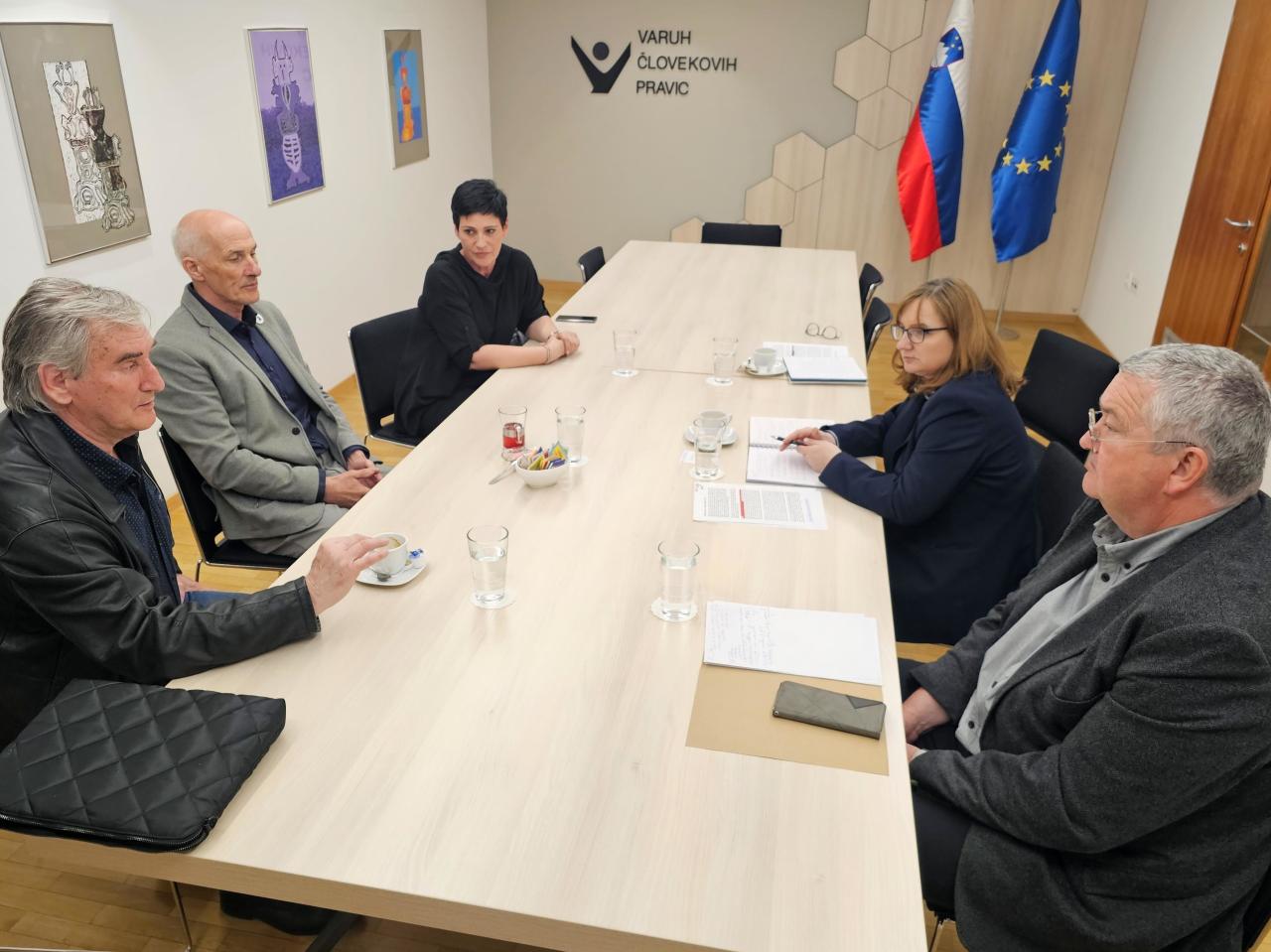
Dr Simona Drenik Bavdek, the Human Rights Ombudswoman, together with her deputy, Ivan Šelih, met today with representatives of Društvo sodnikov porotnikov Slovenije. At the meeting, the representatives presented the association’s mission and activities, as well as the challenges they face and an initiative for support and cooperation with the Ombudsman.
Dr Simona Drenik Bavdek received representatives of Društvo sodnikov porotnikov Slovenije, led by the association’s president, Peter Hartman, a lay judge. Established in 2024 and headquartered in Slovenj Gradec, the association aims to enhance the reputation and standards of the work of lay judges and to strengthen human rights within the judicial system. During the meeting, the representatives presented the role of lay judges, the legal basis for their work, and their experiences from past cases. They also raised certain outstanding issues that they would like to address with the support of the Ombudsman.
They highlighted the need for training, as only one such programme has been conducted in the past thirty years. They also raised issues related to the selection process and criteria for appointing lay judges, the transparency of case allocation, and remuneration for this role. As they emphasised, in practice, the role of lay judges varies across individual courts and judges.
They welcomed the responsiveness of the Ministry of Justice, which has already begun implementing the first set of training programmes; however, further adjustments are needed to ensure that this training will be accessible to all in the future. They believe that most of the issues raised by the association could be resolved within the framework of the Working Group for the Preparation of Systemic Solutions in the Field of the Functioning of Lay Judges, established under the Ministry of Justice last September. However, the group has not yet begun its work and, despite the Ombudsman’s recommendation, no representative of lay judges or of the association has yet been included. The working group would be responsible for addressing procedures and conditions for appointment, the rights and duties of lay judges, measures to improve their role or status, the preparation of proposals for systemic solutions, and examining the appropriateness of the level of remuneration for lay judges’ participation in court proceedings.
The Ombudswoman emphasised that lay judges are an important part of the judicial system, particularly in terms of delivering judgments on behalf of the people. She supported their initiative regarding training and cited the training of refugee counsellors as a model. In her opinion, it would be appropriate to regulate mandatory training for lay judges by law. She also believes that the appointment of lay judges should be standardised to ensure that the selection process is in line with regulations, independent and non-political, while respecting the separation of powers. She further considers that the application process should be accessible to any citizen who meets the requirements.
The Ombudswoman also agreed that their work must be appropriately valued, given that some lay judges take time off work on the day of the hearing, cancel private commitments, or even planned holidays. Appropriate remuneration would also increase the number of candidates and enhance both the reputation and the quality of lay judges. The Ombudsman will review their proposals together with the Ombudsman’s staff and, within the scope of the Ombudsman’s powers, advocate for strengthening the rule of law and ensuring the proper functioning of lay judges and trust in the judiciary.
Lay judges are not professional judges, but citizens of various ages, educational backgrounds, professions, and other personal characteristics. They are directly involved in the exercise of judicial authority. They ask questions of the parties/defendants, witnesses, and experts, and participate in decision-making. They bring a lay perspective to proceedings, which can contribute to fairer judgments and help judges view cases from another angle, often from a practical perspective. Lay judges participate in criminal proceedings, including those against minors before district courts, as well as in proceedings before labour and social courts.


 Back
Back