The Human Rights Ombudswoman meets with the Office of the Government of the Republic of Slovenia for Nationalities to address Roma issues and strengthen dialogue


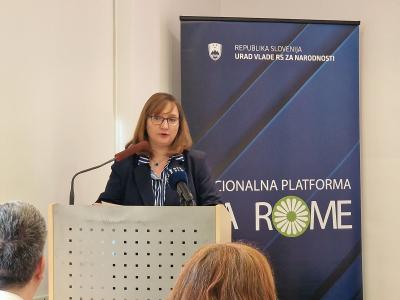
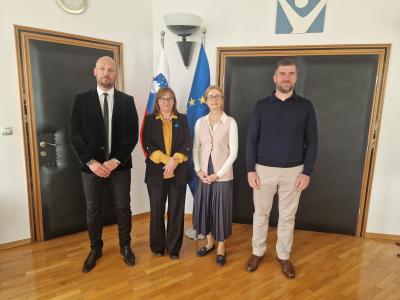
Today, the Human Rights Ombudswoman, Dr Simona Drenik Bavdek, met with representatives of the Office of the Government of the Republic of Slovenia for Nationalities. The meeting aimed to strengthen cooperation between the two institutions, with discussions focusing on issues related to the Roma community and the regulatory framework governing Roma issues, as well as on ways to strengthen dialogue at national and local levels.
Dr Simona Drenik Bavdek received Danica Polak Gruden, Director of the Office of the Government of the Republic of Slovenia for Nationalities, together with her colleagues. Various issues and areas related to addressing the situation of the Roma community were highlighted, as well as the roles of the state, municipalities, and the Roma community in exercising rights. "The state should implement programmes and projects more effectively at various levels to improve living conditions, infrastructure, education, employment, healthcare, social protection and the integration of the Roma community, while ensuring security, the effective prosecution of crime, and equal rights for all," the Ombudswoman emphasised.
The most prominent recent event in the public sphere in connection with Roma issues has been the tragic incident in Novo Mesto and the subsequent adoption of the Act on Urgent Measures to Ensure Public Safety (ZNUZJV). The Constitutional Court has recently adopted a decision to suspend the enforcement of Article 8 of the Act. The Ombudsman explained that several inquiries had been conducted regarding the ZNUZJV, with additional clarifications obtained. Among other things, the Ombudsman is examining why a large number of high-value fines remain unpaid in practice, despite existing enforcement mechanisms. The Ombudsman also highlighted other problematic aspects of the Act, such as entry into private dwellings and other premises, the use of technical means in security-risk areas (e.g. drones), restrictions on access to free legal aid, interference with social rights, and the establishment of security zones. Before reaching final conclusions, the Ombudsman intends to engage in dialogue with the new Government regarding provisions of the Act that raise constitutional concerns regarding impermissible interference with human rights.
The interlocutors also emphasised the need to work more intensively with the Roma community to improve their prospects after completing their education. “It is necessary to demonstrate the purpose of their full inclusion in institutions and voluntary organisations, from kindergarten and school to further education, sports, cultural activities and, ultimately, employment.” Many Roma discontinue activities they have started and withdraw from further participation due to a perceived lack of purpose and motivation. This is further reinforced by negative stereotypes about the Roma community among the local population, employers and institutions, which consequently offer too few employment opportunities. The Ombudsman has also recorded cases of discriminatory treatment in recruitment procedures. The interlocutors agreed that individual examples demonstrate that Roma can be reliable and valuable employees who contribute significantly to companies and society as a whole. A positive awareness-raising campaign presenting who Roma are and highlighting positive examples would also be beneficial.
The discussion also addressed the issue of limited responsiveness within parts of the Roma community. The Office has observed a lack of active cooperation from Roma councillors, which hinders the implementation of certain projects and causes many initiatives to remain stalled or progress slowly. The meeting also addressed housing conditions, including efforts to resolve them at the local level by accelerating legalisation processes and identifying alternative solutions. In this context, the interlocutors discussed the progress of pilot projects currently underway in Krško, Novo Mesto and Črnomelj, among other locations.
The Ombudswoman also raised the issue of the lack of disaggregated data on members of the Roma community, which hinders the effective implementation of inclusion policies and the monitoring of their effectiveness. “Slovenia lacks data, which prevents us from designing effective measures and gaining insight into the actual situation,” the Ombudswoman emphasised. This issue has also been highlighted by the European Commission against Racism and Intolerance (ECRI) and the United Nations Committee on the Elimination of Racial Discrimination (CERD), both of which emphasise the need to collect quantitative and qualitative data, which are essential for planning, implementing and evaluating measures.
At the conclusion of the meeting, the Ombudswoman emphasised that there is still a great deal of work to be done in this area and that efforts must be intensified without delay to address the numerous challenges that remain. In her view, without systematic and comprehensive evaluation, as well as regular and transparent reporting, it will not be possible to ensure the effective implementation of the National Programme of Measures for Roma (NPUR 2021–2030). “We must therefore work together to find solutions; meetings such as today’s represent an important step forward and a positive indication that progress is possible.” The Ombudswoman will also attend the national consultation “The Importance of Education and the Preservation of Roma Cultural Heritage” tomorrow, co-organised by the Office of the Government of the Republic of Slovenia for Nationalities.


 Back
Back