Ombudswoman: "Accessibility is a fundamental human right, not an extra or a privilege."


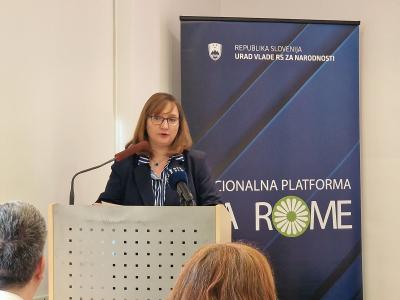
‘Accessibility is a fundamental human right, not an extra or a privilege. It is the way society lives and breathes, opening up spaces for everyone or stifling and excluding,’ emphasised the Human Rights Ombudswoman, Dr Simona Drenik Bavdek, today at the presentation of the results of the Enabling Multimodal Mobility for Persons with Various Disabilities project.
In her opening address, the Ombudswoman assessed that the project, implemented by the Geodetic Institute of Slovenia with support from the National Council of Disability Organisations of Slovenia and funded by the Ministry of the Environment, Climate and Energy, makes an important contribution to improving the lives of persons with disabilities and consequently to creating a more inclusive society.
‘From a human rights perspective, it is extremely important, as it promotes equality in society and prevents exclusion and discrimination. Ensuring equal opportunities, removing barriers, and enabling persons with disabilities to exercise their rights is at the core of the UN Convention on the Rights of Persons with Disabilities. Projects such as the one presented today are important not only because of their innovative technical solutions, but above all because of their humanistic message: the space in which we live must be accessible to everyone,’ said Dr Drenik Bavdek. The ombudswoman believes that the project plays a key role in breaking down the barriers that prevent individuals from fully participating in community life.
Accessibility refers not only to barriers to mobility, but also to access to information, communication and services, and to every individual's ability to participate in society on an equal footing.
‘Therefore, as a society, we must also be aware of the barriers arising from sensory impairments, such as visual and hearing impairments, and neurological differences, as well as those related to intellectual disabilities. Last but not least, as an increasingly ageing society, we must not overlook the limitations associated with ageing,' she explained. In Slovenia, it is estimated that nearly half a million people face daily barriers when accessing essential services for a good quality of life.
Dr Drenik Bavdek also noted that there remains a significant gap in Slovenia between the legal framework and the situation in practice.
'Under the Equalisation of Opportunities for Persons with Disabilities Act, all publicly accessible buildings should have been universally accessible by 11 December last year. However, examples from practice unfortunately show otherwise,' she said. She added that the digitalisation of healthcare services and communication with institutions, organisations, centres and agencies must not restrict the right to information or access to medical care.
'A society that includes its most vulnerable members must become the society of the future. However, inclusion must not remain merely a slogan; it must become a legally and practically guaranteed reality. When we design spaces and services with people in mind, we are truly on the right path to becoming an inclusive society that adapts to people's needs. In Slovenia, however, this path is far from complete,” she concluded.

 Back
Back