
Human Rights Ombudswoman discusses the situation of the Slovenian minority in Austria with the Austrian Ambassador


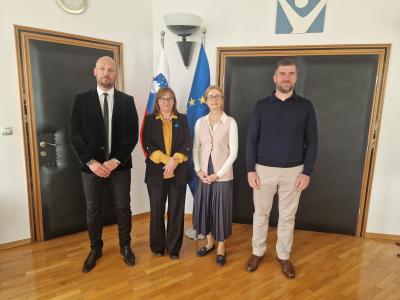
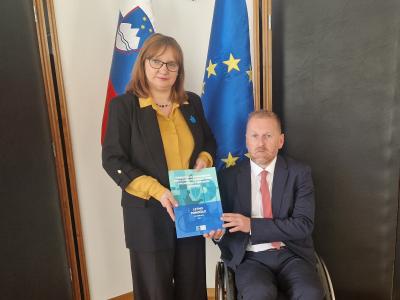
On 9 April 2026, the Human Rights Ombudswoman, Dr Simona Drenik Bavdek, met with the Austrian Ambassador to Slovenia, Dr Konrad Bühler, at the Human Rights Ombudsman of the Republic of Slovenia. They discussed current human rights issues, with a particular focus on the situation of the Slovenian national community in Austria.
Dr Bühler presented Austria’s activities and positions, emphasising the importance of dialogue and cooperation on minority issues. Dr Drenik Bavdek noted that the Human Rights Ombudsman of the Republic of Slovenia (the Ombudsman) maintains good relations with the Austrian ombudsman institution, which operates as a three-member body. One of its members also serves as Secretary General of the International Ombudsman Institute (IOI). The Ombudsman has for years monitored the situation of Slovenian communities abroad and supports efforts to ensure respect for their rights within international mechanisms. “Many human rights cases extend beyond national borders. Therefore, I strive to strengthen bilateral cooperation between comparable institutions to promote the human rights of individuals, including in cross-border cases,” added the ombudswoman.
She noted the institution’s observation that numerous cases and international processes point to a gap between the normative framework and the actual implementation of the rights of the Slovenian minority in Austria. In accordance with Article 7 of the Austrian State Treaty, the Human Rights Ombudsman of the Republic of Slovenia monitors issues related to the use of the Slovenian language in judicial and administrative proceedings, the lack of adequate translations, the inconsistent implementation of bilingual topography, access to quality bilingual education, and the consistent use of bilingualism in the public sphere.
She referred to an important example: court proceedings in Carinthia, which confirmed that a Slovenian citizen, as a citizen of the European Union, must not be discriminated against when using the Slovenian language in court proceedings in bilingual areas. “The case confirms the importance of equal treatment and highlights the need for clear and consistent practices in the implementation of language rights,” she said. The Ombudsman also reported on this in the Ombudsman’s report to the National Assembly for 2023 (p. 152).
The interlocutors also discussed lengthy denationalisation procedures and agreed that open, professional and regular dialogue is essential for the effective implementation of human rights, including minority rights, and for further strengthening good relations between the two countries.

 Back
Back