Five Years since Obtaining A Status under the Paris Principles: The Ombudsman is a Resilient and Independent Institution, but It Also Needs a Legally Appointed Head


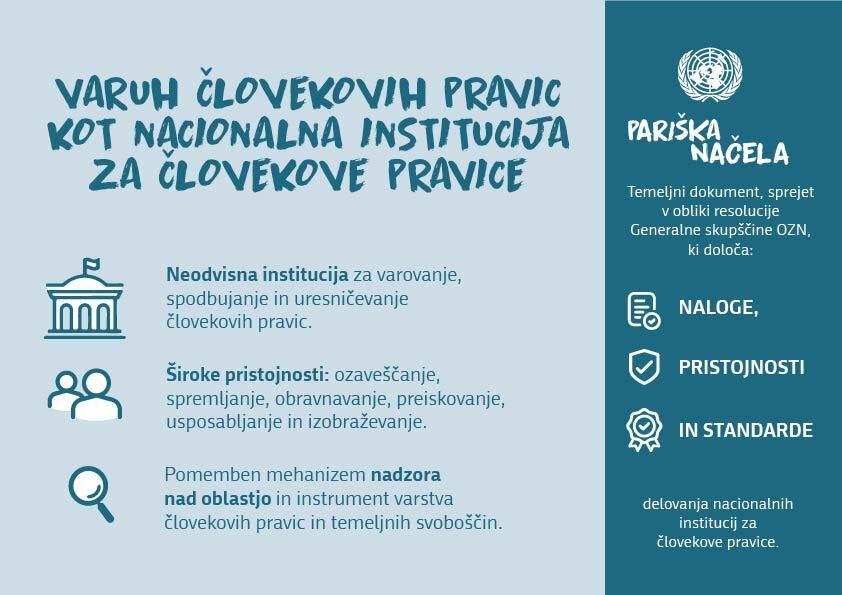
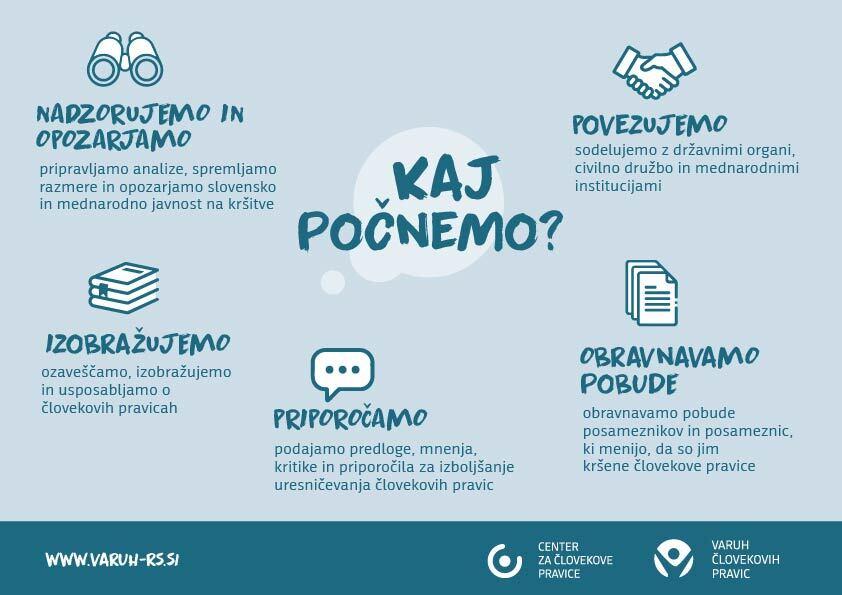
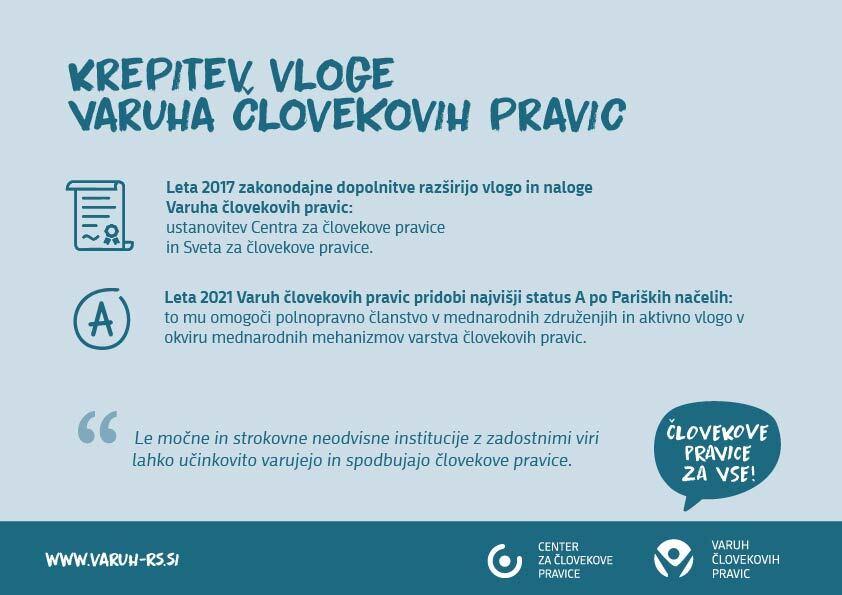
On the fifth anniversary of its accreditation with A status under the Paris Principles, endorsed by the United Nations General Assembly in Resolution A/RES/48/134, the Human Rights Ombudsman of the Republic of Slovenia (hereinafter: the Ombudsman) has prepared an infographic aimed at further raising awareness of the importance of a national human rights institution within the system of checks and balances. Reaccreditation, which takes place every five years, is currently underway, and the Ombudsman will present its compliance with the Paris Principles before the Subcommittee on Accreditation (SCA) of the Global Alliance of National Human Rights Institutions (GANHRI) in April 2026.
Achieving A status under the Paris Principles signifies international recognition of the credibility, professionalism and independence of an institution with a broad mandate to promote and protect human rights. In its assessment, the Subcommittee on Accreditation also considers financial autonomy, pluralism and the effectiveness of the institution.
The key activities and achievements of the Ombudsman as a national human rights institution with A status under the Paris Principles include:
- Since 2019, the Ombudsman has regularly prepared independent reports on the state of human rights and the rule of law in Slovenia and submitted them to various international and regional human rights mechanisms within the United Nations, the Council of Europe and the European Union. In recent years, it has submitted information to the Human Rights Committee, the Committee against Torture, the Committee on the Elimination of Discrimination against Women, the Committee on the Rights of the Child, the Committee on the Rights of Persons with Disabilities, the Group of Experts on Action against Trafficking in Human Beings, the Group of Experts on Action against Violence against Women and Domestic Violence, the Committee of Experts under the European Charter for Regional or Minority Languages, and the European Commission in the context of the rule of law. The Ombudsman has also participated in a plenary session of the United Nations Human Rights Council regarding the report of the Special Rapporteur on Human Rights and the Environment. In these reports, the Ombudsman highlights key recommendations and identifies shortcomings in the implementation of international human rights standards in Slovenia. In its capacity as a national human rights institution, the Ombudsman also prepared a third-party intervention before the European Court of Human Rights in the case of X and Others v. Slovenia.
- The Ombudsman is increasingly recognised by international monitoring mechanisms as a source of expert and independent information on the state of human rights and the rule of law in the country. This is reflected in regular visits by representatives of various European and international bodies during the preparation of national reports. Last autumn, the Ombudsman also hosted the United Nations High Commissioner for Human Rights, Dr Volker Türk, during his visit to Slovenia.
- In its capacity as a national human rights institution, the Ombudsman has also published several analyses in recent years, including the first comprehensive analysis of the prosecution of hate speech in Slovenia for the period 2008–2018 (2021), an analysis of the training of public servants in human rights (2022), a guide entitled How and When to File a Complaint with the United Nations Treaty Bodies? (2022), a publication on international standards governing the work of the Human Rights Ombudsman of the Republic of Slovenia (2023), a publication marking the 30th anniversary of the Ombudsman’s work (2024), and an informational brochure entitled We Older People Have Rights Too (2024, 2025). This year also marks the fifth edition of the Ombudsman’s public call for bachelor’s, master’s and doctoral theses in the field of human rights. The Ombudsman also publishes regular quarterly reports on its activities relating to the human rights of persons with disabilities.
- Over the past five years, the Ombudsman has organised numerous events—seminars, conferences, webinars and consultations—aimed at raising awareness and promoting human rights. Particular attention has been paid to the rights of older persons, children’s rights, human rights in the economy, and the rights of persons with disabilities, as well as to human rights education for both senior public officials and primary and secondary schools.
- Through these activities, the Ombudsman has further strengthened its visibility among international partners. It has obtained voting rights within GANHRI and the European Network of National Human Rights Institutions (ENNHRI). In recognition of its expertise and work, a representative of the Ombudsman was elected to the ENNHRI Executive Board for a three-year term in October 2024. The same representative also co-chairs the Legal Working Group, while another representative chairs the Working Group on the Convention on the Rights of Persons with Disabilities and is a member of the Working Group on the Rights of Older Persons within GANHRI. Several other representatives of the Ombudsman are also members of ENNHRI working groups. Close cooperation within ENNHRI and GANHRI enables the exchange of views and experiences, provides insight into the functioning of similar institutions, and supports participation in the development of European policies based on respect for human rights, the rule of law and democracy.
- In its second Voluntary National Review of Slovenia on the implementation of the 2030 Agenda for Sustainable Development, the Government highlighted the establishment and functioning of the Human Rights Centre within the Ombudsman as an example of good practice.
- The Human Rights Council of the Ombudsman, composed of representatives of civil society, academia and state bodies, has served as an advisory body, thereby contributing to the implementation of the principle of pluralism. However, the Council is currently inactive due to the vacant position of Ombudsman, which negatively affects the fulfilment of this principle.
The Ombudsman considers that it carries out its mandate as a national human rights institution responsibly and in accordance with the Paris Principles. At the same time, it reiterates that the fact that the institution has been without a head for a full eleven months—despite demonstrating resilience and continuing, for the most part, to carry out its tasks without disruption—indicates that human rights are not among the priorities of political decision-makers. This is particularly concerning given that more than 30 candidates have applied for the position; following one unsuccessful nomination, Parliament is expected to decide shortly on a second proposed candidate.
The Ombudsman calls on those responsible to take all necessary steps to ensure that the institution is provided with a duly appointed head as soon as possible, with a mandate supported by at least a two-thirds majority of the National Assembly. Only in this way will the current unlawful situation come to an end—one in which the institution, without a head, must respond to complex social challenges and exercise its full authority in addressing human rights violations.
 Back
Back