
At an International Conference in Pristina, Kosovo, Dr Simona Drenik Bavdek on the Future of Human Rights in the Time of Global Transformations


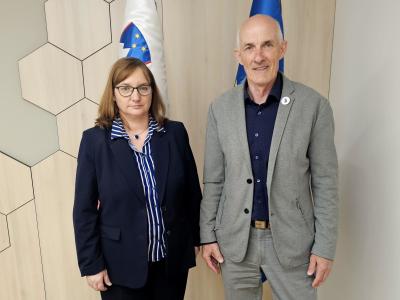
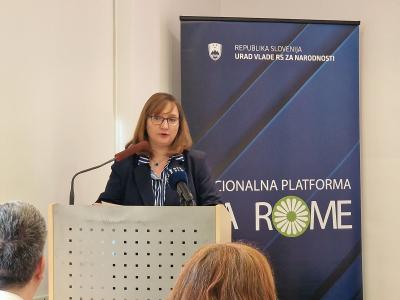
On 2 and 3 December 2025 in Pristina, Kosovo, a High-Level International Conference on the Future of Human Rights in the Time of Global Transformations was dedicated to the 25th anniversary of the Institution of the Kosovo Ombudsman. Key representatives of international and regional institutions and networks for human rights debated national challenges and international obligations in a time of political, social, and technological shifts. As an invited speaker, the conference was also attended by Dr Simona Drenik Bavdek, member of the Board of the European Network of National Human Rights Institutions (ENNHRI) and Assistant Head of the Center for Human Rights at the Human Rights Ombudsman.
Dr Drenik Bavdek highlighted that human rights are increasingly under pressure from global crises ranging from the consequences of wars and geopolitical tensions to the climate crisis and environmental protection, technological challenges and artificial intelligence, increasing inequalities, and disinformation on the increase. “When we speak about dignity, freedom, and equality, we often speak about great, almost idealistic phenomena. However, these values are not to be taken for granted. Conflicts, fears, social tensions, and inequalities endanger what we consider the foundation of coexistence. When these pressures are further connected with the occurrence of disinformation, what we have in common – trust – starts crumbling,” she added. She reminded that the United Nations define disinformation in general as wrong or misleading information created and spread with the purpose of harming or misleading the population. When such information spreads they shatter the trust between people, trust in institutions, and the ability of a community to respond with solidarity and thought. Together with various algorithms on social networks, this causes the polarisation of society, distrust towards science, a decrease in the importance of human rights, and encourages hate speech.
Furthermore, Dr Drenik Bavdek warned that, in such a context, the political tendency of “safety first” becomes very appealing and can lead to so-called securitisation, which signifies the transformation of social or political questions into alleged existential threats demanding emergency measures. “This is where human rights start being in peril – when they begin to be surpassed by the logic of urgency, order, or safety. When there is no expert debate, nor is the contextual impact assessment of measures on human rights carried out. When certain groups are presented as a security risk, when control strengthens faster than the control of authority, when fear starts replacing fairness. Such an approach has been detected by national institutions for human rights in an increasing number of European countries,” she emphasised.
Moreover, human rights must never be comprehended as a luxury of peaceful times: “It is in times of crisis that they have to remain a foundation. Rights signify dignity – regardless of whether we are dealing with refugees or citizens, minorities or the majority, rich or poor.” Considering recent tendencies of several European countries, in the name of ENNHRI Drenik Bavdek called upon those responsible to ensure respect for the rule of law and independence of the European Court of Human Rights in the treatment of questions related to migration and the European Convention on Human Rights.
As a representative of ENNHRI, she highlighted that strong and independent national institutions for human rights are one of the key pillars of democratic societies and of the system of checks and balances, which is also emphasised by the European Commission. They function as a bridge between the state, civil society, and international mechanisms, provide expert analyses, bring attention to violations, support vulnerable groups, and contribute to national and international crisis resilience.
ENNHRI notices that numerous European national institutions face staffing and financial limitations, that their recommendations frequently remain unrealised, and that an increasing number of countries are reporting political pressures, online and physical threats, and legislative attempts at limiting their independence. In 2025, no fewer than one in four institutions reported serious threats to their independent operation, which reveals a worrying trend in the European environment.
Drenik Bavdek also introduced ENNHRI’s strategic directions for 2026–2030, which are focused on strengthening and protecting the independence of national institutions for human rights, greater resilience of institutions in critical circumstances, the linking of human rights, democracy, and the rule of law, and the necessity of alliances among countries, institutions, and civil society. In the conclusion she added that national and international mechanisms are crucial for the defence of human rights and the rule of law. It is only through common action that we can ensure that human rights remain the common core of society in times of uncertainty.


 Back
Back