
Human Rights Ombudswoman: “Care for persons with dementia in Slovenia is also not adequately regulated”


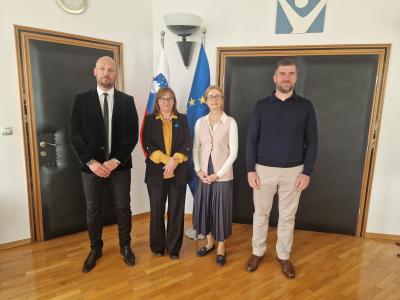
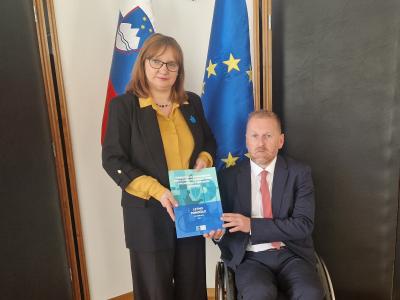
Today, on 9 April 2026, Dr Simona Drenik Bavdek, the Human Rights Ombudswoman, met with Štefanija L. Zlobec, President of Spominčica – Alzheimer Slovenia, and Dr Zdenka Čebašek Travnik, a member of the association’s expert council. Together, they highlighted a number of systemic shortcomings in the care of persons with dementia and committed to continuing their joint efforts to strengthen the protection of the rights of persons with dementia and their relatives. “Only systemic solutions can ensure consistent respect for human rights, dignity, and the individual needs of older persons, especially those with dementia,” the ombudswoman stressed.
The meeting was also attended by the Deputy Ombudsman Ivan Šelih, the Deputy Ombudsman Dr Dijana Možina Zupanc, and the Secretary of the Ombudsman’s Human Rights Council Dr Kornelija Marzel.
The interlocutors agreed that many of the difficulties faced by persons with disabilities in exercising their rights stem from an inadequate translation of the Convention on the Rights of Persons with Disabilities (CRPD), leading to the ineffective implementation of the rights guaranteed by the Convention. The CRPD defines persons with disabilities as “those who have long-term physical, mental, intellectual or sensory impairments which, in interaction with various barriers, may hinder their full and effective participation in society on an equal basis with others.” National legislation, however, is based on formally recognised disability status, granted under various regulations that also confer different rights. This approach is not in line with the Convention. As a result, persons with dementia, for example, are rarely able to obtain disability status and are therefore excluded from many rights, such as access to a disabled parking card. The interlocutors emphasised the urgent need to align national legislation with the CRPD—an issue the Ombudsman has been raising for several years—and to ensure an appropriate translation of the Convention to avoid further misunderstandings.
The ombudswoman noted that care for persons with dementia in Slovenia is not sufficiently developed at a systemic level, with a frequent lack of specialised programmes, dedicated units, and adequately trained staff. “Persons with dementia are not always treated in line with their specific needs, which can affect their safety, dignity, and quality of life. They are often among the vulnerable groups overlooked in decision-making. Relatives of persons with dementia also lack sufficient support, respite services, and professional guidance,” warned Dr Drenik Bavdek.
The President of Spominčica – Alzheimer Slovenia stressed that dementia is one of the most costly conditions for society and represents a significant burden for caregivers. She added that dementia should be integrated across all levels and fields of healthcare education.
Representatives of Spominčica – Alzheimer Slovenia also pointed to a number of other areas where persons with dementia and their relatives face difficulties. They highlighted situations in which ensuring a person’s safety may conflict with their personal freedom and right to privacy. The system for accompanying persons with dementia to healthcare institutions is also inadequately regulated. “Many unrealistic decisions are made in offices that have a profound impact on the lives of persons with dementia and their relatives,” warned the President of Spominčica – Alzheimer Slovenia.
“Many people in the advanced stages of dementia remain in hospitals due to a lack of appropriate placements, which places a significantly higher financial burden on the state. Alternatively, they remain at home—which is, in fact, even worse,” said Štefanija L. Zlobec. Dr Zdenka Čebašek Travnik called for more coordinated cooperation in searching for and locating persons with dementia, which currently falls under the responsibility of four different ministries. As an example of good practice, she highlighted the project You Are in Our Minds (YOMI), which has developed methodologies for locating such persons.
The interlocutors expressed satisfaction with the successful cooperation between the Ombudsman and Spominčica – Alzheimer Slovenia. Notably, in 2017 the Ombudsman’s premises became the first dementia-friendly point in Slovenia. The network now includes more than 500 dementia-friendly points and represents an important step towards greater accessibility and awareness of the needs of persons with dementia.
The ombudswoman also highlighted the role of the National Preventive Mechanism (NPM), which operates within the framework of the Ombudsman. In line with the Convention against Torture and Other Cruel, Inhuman or Degrading Treatment or Punishment, the NPM regularly visits places of deprivation of liberty, including care homes and hospitals where persons with dementia are accommodated. These visits aim to strengthen protection against torture and other forms of cruel, inhuman or degrading treatment or punishment. In 2025, the NPM visited several care homes for older persons, assessing, among other things, whether persons with dementia are treated with dignity and respect, whether deprivation of liberty is lawful, and whether appropriate living, healthcare, safety, social, and other conditions are ensured.
More broadly, the ombudswoman noted that the healthcare system faces long-standing systemic challenges that particularly affect vulnerable groups, including older persons and persons with dementia. Waiting times remain excessively long, which may lead to a deterioration in health and loss of functionality. Limited capacity following hospital discharge places additional pressure on families, who often lack the knowledge or support needed to care for persons with dementia. Weak coordination between the healthcare and social systems creates gaps in care, particularly for older persons and persons with dementia. Difficulties in accessing mental health services, including treatment for neurological and cognitive disorders, further aggravate their situation.
The ombudswoman therefore reiterated the need for systemic solutions in this area, including long-term staffing policies, the expansion of care capacities, improved coordination between systems, and ensuring accessible, timely, and dignified care for older persons and persons with dementia.
 Back
Back