
Human Rights Ombudswoman in Geneva: ‘In a time of global challenges and digital transformation, it is essential to strengthen the role of independent national institutions.’


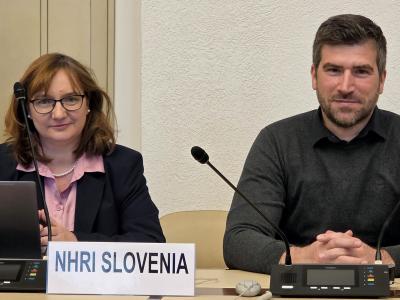
Dr Simona Drenik Bavdek, the Human Rights Ombudswoman, together with Deputy Ombudsman Miha Horvat, attended the annual meeting of the Global Alliance of National Human Rights Institutions (GANHRI), held from 30 March to 1 April 2026 at the Palais des Nations in Geneva. The meeting brought together representatives of national human rights institutions from around the world and provided a central global forum to discuss their role at the national, regional and global levels, current challenges in the field of human rights, the exchange of good practices and the shaping of common orientations.
The discussions took place at a time when the international human rights protection system, international law and multilateralism are facing serious challenges. In many countries, the space for civil society is shrinking, pressure on independent institutions is increasing, and disinformation and polarisation are intensifying. At the same time, there has been a noticeable regression in the protection of the rule of law and fundamental rights. National human rights institutions therefore operate in an increasingly challenging environment characterised by conflicts, climate change, digital transformation and deepening social and economic inequalities. Nevertheless, they remain key actors in safeguarding human rights at the national level. As independent bodies, they oversee the actions of public authorities, advise legislators, provide protection to individuals, advocate for the strengthening of the rule of law and respect for human rights, and raise public awareness.
At the conclusion of the GANHRI meeting, Ombudswoman Dr Simona Drenik Bavdek emphasised that national human rights institutions are an indispensable part of the global human rights protection system: ‘Their close cooperation is essential for effectively addressing shared challenges, and their role in times of complex global challenges should be further strengthened.’
The first day of the meeting was dedicated to discussions at the regional level within the ENNHRI network, while the second and third days focused on discussions at the global level.
At the GANHRI General Assembly, a significant part of the discussion focused on the exchange of experiences related to the protection of the rights of people on the move, including migrants, refugees and asylum seekers. Dr Simona Drenik Bavdek also took part in the discussion, presenting the activities of the Human Rights Ombudsman (the Ombudsman) in this field. She emphasised that the Ombudsman regularly monitors respect for the rights of people on the move and deals with around 80 migration- and asylum-related cases each year. She also highlighted the need for a dedicated procedure to determine statelessness, as well as shortcomings in identifying victims of trafficking in human beings and ensuring their placement in safe accommodation. As the National Preventive Mechanism (NPM), the Ombudsman regularly monitors the Centre for Foreigners and the Asylum Centre, including their branches, and also addresses challenges related to the inclusion of migrant workers’ children in the education system, learning the Slovenian language and the integration of women, who are often socially isolated.
Dr Simona Drenik Bavdek also presented the Ombudsman’s participation in international procedures related to migration, in particular in cases before the United Nations Committee on the Rights of the Child and the European Court of Human Rights. The Ombudsman has also recently prepared an alternative report for the United Nations Committee on the Elimination of Racial Discrimination (CERD) on the implementation of the Convention in Slovenia. She also highlighted cooperation with the regional office of the United Nations High Commissioner for Refugees.
At a side event on children on the move, ENNHRI Secretary General Debbie Kohner explicitly highlighted, as an example of good practice, the independent intervention of the Ombudsman before the United Nations Committee on the Rights of the Child in relation to a complaint lodged by a minor refugee from Myanmar against Slovenia. In this intervention, the Ombudsman detailed violations related to the failure of the Slovenian police to carry out an individual assessment, to recognise the person as a minor, to respond to asylum requests, and to respect the principle of non-refoulement. The Committee has not yet taken a decision in this case.
The discussion on the rights of people on the move highlighted the increased risk of human rights violations at borders and in transit, as well as the importance of independent oversight of the conduct of state authorities, early warning of systemic irregularities and ensuring access to fundamental rights and services. National human rights institutions play a particular role in this regard, as they can contribute to the prevention of violations and to more inclusive policies through monitoring, handling complaints, issuing recommendations and cooperating with the relevant authorities.
On the third day of the meeting, the annual conference took place, including an interactive discussion between representatives of national human rights institutions and the United Nations High Commissioner for Human Rights, Volker Türk. The High Commissioner emphasised that national institutions are natural allies in his efforts within the global alliance for human rights, which aims to promote respect for human rights standards in today’s turbulent world. He also invited national institutions to actively engage in the ‘Human Rights Cities’ initiative. Ombudswoman Dr Simona Drenik Bavdek added: ‘The discussion shows that the silent majority in every country seeks stability, cares about others and supports respect for human rights. National institutions have an important role in ensuring that this perspective is not overlooked in public debates.’
The central theme of this year’s GANHRI annual conference was the role of national human rights institutions in promoting and protecting human rights in the digital environment. Participants agreed that digital transformation significantly affects the enjoyment of human rights—it can contribute to greater accessibility of services and inclusion, while also creating new risks such as unlawful surveillance, interference with privacy, discriminatory effects of artificial intelligence, online violence and the spread of disinformation. The use of digital technologies to restrict freedom of expression and the activities of civil society is also of particular concern.
National human rights institutions agreed that the same human rights must apply both online and offline and called on states to establish clear legal frameworks, ensure transparency and accountability, and provide effective oversight of the use of technologies. Access to remedies and the special protection of vulnerable groups, who are often disproportionately affected in the digital environment, are essential. Participants also agreed that particular attention should be paid to the negative impacts of social media on children’s mental health and to their protection from online abuse.
On the margins of the meeting, Dr Simona Drenik Bavdek met with several counterparts, including from Austria, Bosnia and Herzegovina, Finland, Greece, Hungary, Poland, Portugal and Ukraine, and agreed on strengthened cooperation. She also met with ENNHRI Secretary General Debbie Kohner, a representative of the International Ombudsman Institute (IOI), Maarit Kohonen Sheriff, Director of the Division of Global Operations at the Office of the United Nations High Commissioner for Human Rights (OHCHR), and Anita Pipan, Ambassador of Slovenia to the United Nations in Geneva.
The meeting, organised by GANHRI in partnership with the Office of the United Nations High Commissioner for Human Rights (OHCHR), confirmed that national human rights institutions represent a crucial bridge between international standards and their implementation in practice and are an indispensable part of the global human rights protection system. At the global level, GANHRI brings together 119 national institutions, which collectively contribute to the effectiveness of the human rights protection system. It was repeatedly emphasised that ensuring independence, adequate resources and respect for the Paris Principles, which form the foundation of their work, is essential for their effective functioning. The joint conclusions and the adopted declaration represent an important step towards a more coordinated and human rights-based response to contemporary challenges.
More information on the meeting is available on the GANHRI website: https://ganhri.org/ganhri-brin...
 Ombudswoman Dr Simona Drenik Bavdek and Debbie Kohner, ENNHRI Secretary General
 From right to left: Mr. Dmytro Lubinets, Ukranian Ombudsman, Ombudswoman Dr Simona Drenik Bavdek and Jean-Marie Burguburu, President of the National Commission for Human Rights of France
 Interactive discussion with the United Nations High Commissioner for Human Rights, Volker Türk.


 Back
Back